

In high-stakes B2B sales, the biggest risk isn’t losing a deal—it’s spending six months losing a deal you never had a chance to close.
MEDDIC has historically been popular with B2B, tech & Saas sales organizations because it replaces gut feeling with objective data. By qualifying buyers against a rigorous set of criteria, teams can prioritize high-intent accounts and forecast revenue with precision. MEDDIC goes beyond solely qualifying leads and helps with deal management as well.
Below, we’ll explore the mechanics of the MEDDIC methodology and how to integrate it into your existing sales process.
What is the MEDDIC Sales Methodology?
MEDDIC is a rigorous qualification and deal management framework designed to bring clarity to the sales process. By analyzing every opportunity against a specific set of criteria, reps can determine if they are speaking with decision-makers or wasting time on leads that aren’t likely to buy. This approach exposes gaps that could derail a deal months down the line, allowing teams to disqualify bad leads fast and accelerate the winnable ones. The result is a more predictable pipeline, higher win rates, and a significantly shorter sales cycle.
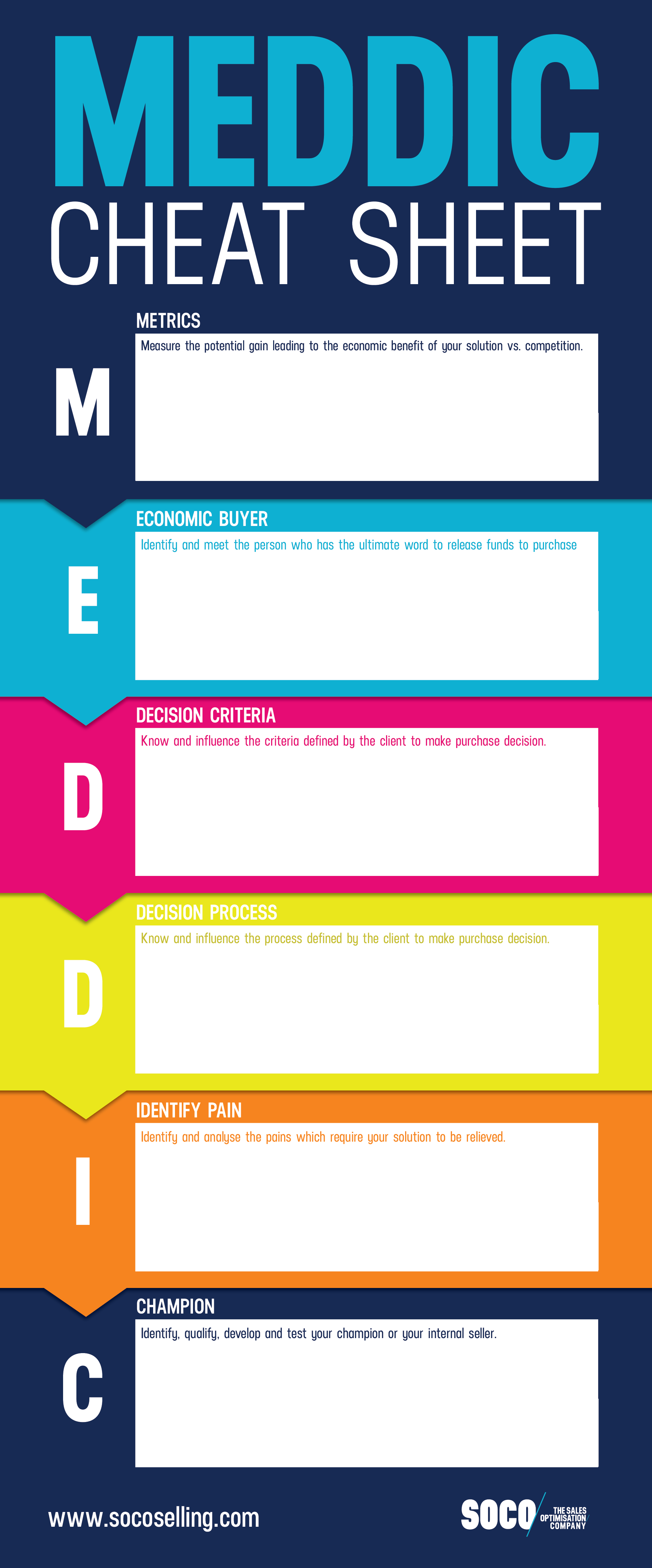
The letters in the MEDDIC acronym stand for the six steps of a deal management process:
How did MEDDIC start?
MEDDIC’s origins date back to the 1990s, where it was pioneered by Dick Dunkel and Jack Napoli at Parametric Technology Corporation (PTC). At the time, PTC was experiencing explosive, unprecedented growth, and the framework was developed as a way to instill discipline into a rapidly scaling sales force. It became the “secret sauce” that helped PTC achieve over 40 consecutive quarters of growth, setting a new standard for efficiency in the tech sector.
The methodology’s success at PTC created a “halo effect,” leading to its adoption by some of the most influential technology giants in the world. Companies like BMC Software, Rational Software, and Bladelogic were among the first to incorporate MEDDIC into their sales procss.
Who is MEDDIC for?
The MEDDIC framework is typically implemented in organizations that are involved in Business to Business (B2B) sales with large deal sizes and multiple stakeholders. Here’s a typical profile of companies who this framework is ideal for:
Complex Enterprise B2B: If your product involves a “buying committee” (Legal, IT, Procurement, and Finance) rather than a single person, you need MEDDIC.
High Average Contract Value (ACV): Generally, MEDDIC is used for deals exceeding $50,000 to $100,000. For smaller, transactional deals ($5k–$10k), the administrative burden of MEDDIC is often overkill.
Long Sales Cycles: If your deals typically take 3 to 18 months to close, MEDDIC provides the “checkpoints” needed to ensure the deal hasn’t gone cold behind the scenes.
SaaS and Deep Tech: Companies selling transformative technology (where the buyer has to change their behavior or infrastructure) benefit most because MEDDIC forces you to identify the “Pain” and “Metrics” required to justify that change.
Why Use a Sales Qualification and Deal Management Framework Like MEDDIC?
Without a framework like MEDDIC, sales teams often fall into the trap of “hoping” a deal closes rather than “engineering” the win. MEDDIC serves as a reality check, replacing ‘having a good feeling’ about an opportunity, to having a ‘clear criteria’ to rate it on. By knowing who the Economic Buyer is and their Decision Process, the framework ensures that teams aren’t just “hoping” for a close, but are actively engineering one.
From a leadership perspective, MEDDIC acts as a universal operating language, aligning the entire sales organization around a single, rigorous standard for deal evaluation. By replacing subjective “gut feelings” with objective, verifiable criteria, the framework eliminates the ambiguity that often leads to bloated pipelines. This allows leadership to generate accurate revenue forecasts based on the actual health of every opportunity.
Ultimately, implementing a framework like MEDDIC significantly increases both sales velocity and overall win rates. IT prevents the last-minute surprises that often derail contracts and drives more predictable growth.
What’s the Difference Between MEDDIC & BANT Sales Qualifying Methodologies?
The MEDDIC and BANT sales qualifying methodologies are two popular frameworks sales teams use to identify and prioritize sales opportunities.
Overall, the main difference between MEDDIC and BANT is their level of complexity and scope.
MEDDIC is a more comprehensive framework that covers all aspects of the sales process and requires a deep understanding of the customer’s business needs and decision-making process.
BANT, on the other hand, is a more straightforward approach that can be quickly applied to assess whether a prospect is a good fit for the sales team’s offerings.
How to Use the MEDDIC Sales Methodology
To use the MEDDIC sales methodology effectively, discover the six key framework elements detailed below (Metrics, Economic Buyer, Decision Criteria, Decision Process, Identify Pain, and Champion.)
Then, apply these elements to your sales opportunities to assess their potential and prioritize your efforts.
Here’s how to do it:
1. Metrics
Asking what your potential customers want is the only way to determine whether your company can fulfill their needs.
You are only wasting your time pushing a solution that doesn’t even address the company’s exact requirements.
The key here is the word exact. It is critical to have your potential customers define a measurable objective that they want to achieve.
For example, if prospects say they want to increase productivity, probe further until you get into specifics, such as the desire to reduce time spent on follow-up calls by 20 percent. This gives you the quantifiable information you can use to sell your solution.
Here are some examples of statements that “show, don’t tell” information points to prospects:
- “Typically, our customers save five hours per week on prospecting once they utilize our product…”
- “We recently had a similar customer of your size that saw a return on investment within just two months of utilizing our service…”
Ultimately, your goal is to present concise outcomes rather than vague, uninspiring promises.
2. Economic Buyer
Who is going to ultimately make the decision when it comes to purchasing your solution? Your sales team member is often not talking to the ultimate decision-maker or the economic buyer.
When using the MEDDIC sales qualification approach, it’s encouraged to, whenever possible, push to speak directly to the decision-maker who has the authority to approve purchases. If it’s in no way possible, attempt to find out in-depth information about the economic buyer from your company contact.
Here are some examples of questions that find out in-depth information about the economic buyer:
- “How does your business typically initiate buying decisions?”
- “Is there any other key stakeholders involved in the buying process?”
- “What’s your specific position in the decision-making process?”
3. Decision Criteria
Remember that you are not the only company pitching your solution to the prospect. The economic buyer has alternative options.
By determining the factors a prospect uses when making a buying decision, you will decide whether your company can meet these buying criteria.
This decision will also enable your team to create a sales presentation that addresses these criteria.
Factors for choosing one product over another may include the pricing features, name recognition, onboarding assistance, industry reputation, the available support level, and the ease of integration with existing infrastructure.
Try asking:
- “What criteria will you be using to make a decision?”
- “What’s the most important factor to you when deciding who you’ll go with?”
4. Decision Process
Ultimately, insights into a prospect’s decision-making process help to prevent losing out on a possible deal. Every company has a different timeline for making purchases. Therefore, when your team knows the prospect’s approval process, it can ensure that contracts and agreements are in place when they are needed.
At this stage, your lead is at least evaluating your product for purchase. Therefore, there are some things you can do to speed up their decision-making process, such as:
Providing a sales demonstration or a free trial of your product or service. As well as following up with them to confirm the typical timeline for making decisions.
To find out the prospects’ decision process try asking questions like:
- “How are these decisions typically made at your company?”
5. Identify Pain
Companies, like people, rarely make changes for the sake of change alone. Most businesses are looking to buy their way out of an existing problem.
If you can identify these problems or pain points, you will determine if your solution can help them overcome these issues.
To make the most effective sales presentation, discover the details surrounding these issues to allow your sales team to showcase how your product or service can help deal with these specific struggles.
To identify pain, try asking:
- “What prompted you to start looking for this solution?”
- What challenges are you currently facing in your business?
- What are your top priorities or goals for the upcoming quarter or year?
- Are there any processes that are currently causing delays or inefficiencies?
- How are you currently addressing [specific problem area]?
- What impact is [specific issue] having on your business?
6. Champion
Find an insider at your potential customer’s company who will champion you.
This ‘champion’ of your solution doesn’t need to be the economic buyer or even have a supervisory role at the company. But it should be a person whose opinion matters.
One of the best ways to cultivate a champion for your solution is to determine who would benefit the most from your solution in the target company.
Once you locate a champion, the person will actively work towards the company’s adoption of your product.
Variations of MEDDIC: MEDDICC and MEDDPICC
MEDDICC and MEDDPICC are all variations of MEDDIC, typically adding more steps to the process. You can read indepth about the variations here: Sales Qualifying Methodologies – Comparing BANT MEDDIC and MEDDPICC
So, what does it all stand for? Here’s the explanation of the variations of MEDDIC:
- Metrics: Do you understand the impact that this will have on their business and the identified pain? Can you articulate what it is?
- Economic Buyer: Have we had a conversation with the economic buyer?
- Decision-Making Process: Do we understand the decision-making process?
- Decision Criteria: Do we know the criteria by which they will make that decision? Do we fit that criterion? Even better, have we maybe helped that prospect frame the criteria?
- Process: The fun stuff or The Paperwork Process. You have to be an approved vendor. Are there any NDAs you have to sign? Just get your paperwork in order.
- Identified Panic: What are your prospect’s issues? What motivates them?
- Competitors: what’s the competitive landscape? Who else are you up against?
- Champion: Your champion is someone who can answer questions for you, such as: what’s going on internally? What do people enjoy about your solution? and so forth.

How to Choose The Right Approach MEDDIC Vs MEDPICC?
Choosing between MEDDIC and MEDDPICC will depend on the complexity of the sale, the sales cycle, and the organization you’re selling to.
If you’re dealing with a complex sale that involves multiple stakeholders and a long sales cycle, then MEDDPICC may be more appropriate.
On the other hand, if you’re selling to a smaller organization with a more straightforward sales cycle, MEDDIC may suffice.
Luckily, there are some questions you can ask yourself to reflect on your current process. For instance:
- How complicated is the paperwork process? Does it often get lost in approval chains?
- What is the complexity of the sale? If the sale is complex and involves multiple stakeholders, MEDDPICC may be the better choice as it provides a more comprehensive framework to navigate the buying process.
- What is the size of the organization? If the organization is small and has a simpler sales process, MEDDIC may be sufficient.
- How long is the sales cycle? If the sales cycle is long, MEDDPICC may be better suited as it provides a more detailed process for managing each cycle stage.
- What are the decision-making criteria? If the decision-making criteria are complex and involve multiple factors, MEDDPICC may be more appropriate as it provides a more comprehensive framework to assess these criteria.
- What are the consequences of not taking action? If the consequences of not taking action are severe, MEDDPICC may be more effective as it includes a step to implicate the consequences of not taking action.
- What bureaucratic steps are necessary to close the deal? If you need to obtain approvals or navigate internal processes, MEDDPICC may be more effective as it includes a step to understand the paper process.
Ultimately, by asking yourself these questions, you can determine which approach best suits your sales situation and choose the one that will help you navigate the buying process more effectively.
MEDDIC Sales Methodology FAQ
MEDDIC is a sales methodology that provides a structured framework for salespeople to follow when qualifying prospects and closing deals. The acronym stands for Metrics, Economic Buyer, Decision Criteria, Decision Process, Identify Pain, and Champion.
The MEDDIC sales process was developed by Dick Dunkel and Jack Napoli in the late 1980s while working at PTC, a software company in the United States.
MEDDIC and MEDDPICC are both sales methodologies, but MEDDPICC is an extended version of MEDDIC. MEDDPICC includes two additional steps – Paper Process and Identify Competition – which are focused on managing the internal bureaucracy and competitive landscape.
Use MEDDIC when the sales cycle is straightforward and the organization is relatively small. Use MEDDPICC when the sales cycle is complex, and multiple stakeholders are involved.
MEDDIC helps salespeople close deals by providing a structured approach to the sales process, enabling them to identify the right prospects, understand the decision-making process, and build relationships with champions. By following this framework, salespeople can move the deal forward efficiently and increase their chances of closing the deal.
Identifying pain points is essential in MEDDIC because it allows salespeople to position their product or service as a solution to the prospect’s problems. By understanding the prospect’s pain points, salespeople can make their offering more compelling and increase their chances of closing the deal.
SOCO’s Take on the MEDDIC Sales Methodology
Here at Soco/ Sales Training, we find the MEDDIC sales qualification approach for acquiring customers to be very effective in complex sales with a long sales cycle and multiple stakeholders. Much of the MEDDIC concepts align perfectly with our own approach to complex sales.
- Qualify your Prospects and Sales Leads
- Sales Qualifying Methodologies – Comparing BANT MEDDIC and MEDDPICC
- Learn To Sell Like A Pro: 19 Best FREE Online Sales Training Videos
Stop Wasting Time on Unqualified Leads with the MEDDPICC Framework
Stop wasting time on low-probability leads and start focusing on deals you can actually win. With SOCO’s MEDDPICC Mastery training, your team will move beyond surface-level discovery to master an in-depth framework for identifying and prioritizing prospects.
By implementing MEDDPICC, your reps will gain a sophisticated toolkit for navigating complex buying committees and managing multiple stakeholders with ease. They won’t just “check boxes”; they will develop a deep understanding of the customer’s pain points and strategic priorities, ensuring every interaction is tailored to the specific criteria that drive a “yes.”
Equip your organization with the tools to assess, prioritize, and engage leads effectively. By mastering the art of MEDDPICC, your team will eliminate pipeline bloat, reclaim wasted productivity, and drive predictable revenue growth. Don’t let your most valuable opportunities slip through the cracks—invest in the framework that turns “maybes” into closed-won deals.