


The Importance Of Comparing Sales Qualifying Methodologies
When leads are qualified properly, less time is wasted on people not likely to buy from you, so you can hone in on the ones who are. This is why lead qualification frameworks are imperative to your strategy.
The problem is that many sales teams suffer from a massive knowledge gap. It’s surprisingly common to find reps who “check the boxes” without truly understanding frameworks like BANT or MEDDIC.
This creates a “pipeline illusion” where your sales pipeline management looks full and healthy, but you’re still blindsided at the end of the month when nothing closes.
To actually hit your targets, you have to move beyond surface-level conversations and get rigorous about how you vet every opportunity in your pipeline.
Also read:
Using the MEDDIC Approach to Qualify Prospects and Acquire Customers
By fully understanding different qualifying criteria, reps become clearer about what it takes to progress a sale and what it takes to get more qualified leads.
“This could be Prospecting 101. How do you qualify leads effectively? You need to have a criteria or framework that you use for qualification.”
Tom Abbott
The sales discovery call is the exact moment when you will realize whether a lead is worth pursuing. If they are not a perfect fit for your product or service, it’s time to amicably part ways. Getting to this point will often not be obvious, so choosing the path will take some time.
The real question is: how do you actually choose the right sales qualification framework for your team? Well, you need to first understand how the “heavy hitters” like MEDDIC and MEDDPICC stack up against each other so you can find the best fit for your specific sales cycle.
3 Frameworks to Qualify Leads and Manage Deals Effectively
Choosing a framework isn’t a “one-size-fits-all” decision. In our work with high-growth B2B teams, we see that the most successful organizations match their framework to their deal complexity. You can use BANT, MEDDIC, or MEDDPICC depending on the forecasting and the stages of your sales. So pick the most critical things for your business to see a deal moving forward. Make sure that the stages of your sales actually make sense. You can use this rule of thumb to align your B2B sales cycle with the right methodology:
- BANT: Use for high-velocity, lower-ACV deals with 1-2 stakeholders.
- MEDDIC: Use for mid-market deals with 3-5 stakeholders and sub-90-day cycles.
- MEDDPICC: Use for complex enterprise deals with 5+ stakeholders and formal procurement.
What is BANT?
If you’ve been in sales for more than five minutes, you’ve probably heard of BANT. It’s basically the “OG” of sales qualification. Think of BANT as your first line of defense. It’s a quick, simple way to figure out if a lead is actually worth your time or if you’re just chasing a ghost. If a lead doesn’t have the money, the power to say yes, a real problem to solve, or a timeline to solve it, you probably don’t have a deal.
Here is what the acronym actually stands for:
- Budget: Does the lead have a budget to afford your offering?
- Authority: Does the person you are talking to have the ability or authority to make a purchase?
- Need: Do they need your product or service?
- Timing: Does the prospect have a critical need for your solution now?
Why BANT Often Fails in Modern Consensus Buying
While it’s a great starting point, BANT has changed a lot lately. In the old days, you’d just go down the list and check the boxes. Today, it’s much more about the conversation, and it can often lead to premature disqualification in complex sales environments. Why? Because in complex B2B sales, “no budget yet” often actually means “I need a business case first to get the budget.”
If you disqualify a lead just because a formal budget line hasn’t been drawn, you’re walking away from viable deals where the budget is owned by a committee or emerges later in the cycle.
To stay competitive, treat BANT as an initial screening layer. Once a deal passes this surface-level check, it should “graduate” into a deeper framework like MEDDPICC.
3 Modern BANT Questions For Today’s Reality
- Instead of “What’s your budget?”, ask: “How have you solved this problem until now, and what kind of impact is that having on the team’s closing win rates?” You’re trying to find out the cost of inaction.
- Instead of “Who is the decision-maker?”, ask: “Who else besides yourself will be impacted by this change, and what does their evaluation process look like?”
- Instead of “What’s the timeline?”, ask: “If this isn’t solved by [Date], what are the business implications for your department?”
What is MEDICC or MEDDPICC?
If BANT is for the quick wins, these three are for the heavy lifting. These frameworks are built for complex, enterprise-level sales where there are a lot of moving parts and even more people who can say “no.”
The real value here is about the massive impact of qualified deals on your bottom line. Recent data from Ebsta’s Sales Qualification Report, which analyzed over $48 billion in deals, shows that well-qualified deals are actually 6.3 times more likely to close than poorly qualified ones. Not only that, but they close about 21.6% faster.
When you look at the numbers, the difference is staggering: high qualification scores drive a 50% win rate, while poorly qualified deals settle for just 8%. It really is the difference between having a predictable revenue engine and just “hoping” for the best at the end of the month.
The difference between MEDDIC and MEDDPICC
You’ll often hear these terms used interchangeably, but there’s a specific reason you might choose one over the other.
- MEDDIC is your foundation. It’s perfect for standard B2B deals where you need to identify the economic buyer and the decision criteria.
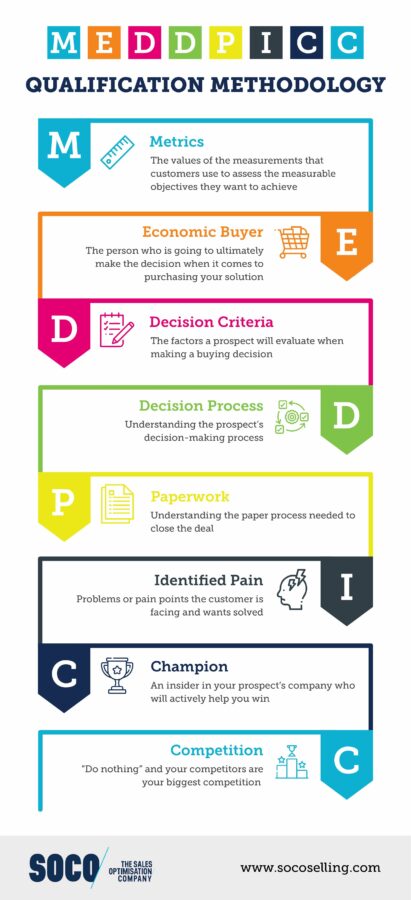
- MEDDPICC is designed for high-stakes enterprise deals where competition is fierce and the legal hurdles are high. It adds the Paper Process (legal/procurement) and Competition, which are essential when you’re dealing with six-month-long cycles and fierce rivals.
The Core Components
- Metrics: Do you understand the impact this will have on their business and the identified pain? Can you articulate what it is?
- Economic Buyer: Have we had a conversation with the economic buyer?
- Decision-Making Process: Do we understand the decision-making process?
- Decision Criteria: Do we know the criteria with which they will make that decision? Do we fit that criterion? Even better, have we maybe helped that prospect frame the criteria?
- Paper Process: The fun stuff or the paperwork process. You have to be set up as an approved vendor. Are there any NDAs you have to sign? Just get your paperwork in order.
- Identified Pain: What is your prospect’s issue? What motivates them?
- Champion: This is your “inside person.” They are someone with power and influence who is actively selling your solution internally when you aren’t in the room. They have a vested interest in your success because they know your product will solve a major problem for them.
- Competitors: What is the competitive landscape? Who else are you up against?
MEDDPICC forces you to plan for those roadblocks early so your deal doesn’t slip past its forecasted date, something Ebsta found well-qualified deals are 1.9 times less likely to do.
What Is Customer Verifiable Outcome?
Rather than scheduling a qualifying call, they’ve organized the qualifying call. They booked the time in my calendar, for example. Rather than I sent them a brochure, they confirm that they went through the brochure. Or they introduced me to someone, or they did this, they did that. It’s not the behavior of the sales rep exclusively. It’s the behavior of that prospect or the customer. What did they do?
Why Qualification Without CVO Still Lies to You
Qualification is a two-way street, but too often, sales reps treat it like a solo act. The biggest trap you can fall into is “ticking the boxes” based on a gut feeling or just hearing what you want to hear. For example, a rep might mark “Identified Pain” as done just because a prospect complained about their current software. But is that real qualification?
Without a Customer Verifiable Outcome (CVO), your qualification is really just a collection of opinions. CVOs force you to look for actual proof. Instead of guessing, you look for observable actions like the prospect sharing internal data and working together to define metrics for success, introducing you to a key stakeholder, or sitting down to define a success plan with you.
This gives you a much more honest picture of the deal’s health. MEDDPICC solves this by tying every stage of your framework to one of these verifiable actions. If the buyer hasn’t acted, the deal hasn’t moved.
What It Looks Like to Apply MEDDPICC in the Real World
Frameworks like MEDDPICC shouldn’t be a “post-call chore” or extra data entry. They are actually the roadmap for the call itself. Here’s how a top-performing rep actually uses it:
Imagine a rep just finished a 30-minute discovery call. Instead of just writing “good call” in the CRM, they open their MEDDPICC scorecard to see what they actually know:
- Metrics: They didn’t just hear “we want to save money.” They dug deeper and found out the prospect needs to reduce churn by 5% to hit their year-end targets.
- Champion: They identified that the Director of Ops is a fan, but they also realized this person hasn’t introduced them to the VP of Finance (the Economic Buyer) yet.
- Competition: They learned the prospect is also looking at two other vendors, so the rep “framed” the conversation around our implementation speed, which the others can’t match.
- Paper Process: They asked a simple “What happens next?” question and found out that their legal review alone takes 30 days.
When a rep uses a scorecard like this to manage their deal, they stop guessing. They can see exactly where the deal is strong and exactly where they need to push for the next “Customer Verifiable Outcome” to keep things moving.
Picking the Right Framework for Your Deal
Nobody wants a bloated pipeline full of deals that go nowhere. To keep things moving, you need to know which tool to pull out of your kit based on the deal in front of you. Think of this table as your “cheat sheet” to match your framework to your sales reality:
| Methodology | Best For… | Stakeholders | Cycle Length |
| BANT | High-velocity / Small Business | 1-2 | < 30 Days |
| MEDDIC | Mid-Market / Standard B2B | 3-5 | 30-90 Days |
| MEDDPICC | Complex Enterprise Deals | 5+ | 6 Months+ |
Matching your Framework to your Market Segment
In our work with various sales organizations, we’ve noticed that the “best” framework usually depends on the complexity of the buyer’s environment rather than just the product itself.
Here is how we typically see these segments play out:
- Enterprise SaaS (Selling into IT, Security, or Legal): In these high-stakes environments, MEDDPICC should be your default. Since you’re dealing with massive procurement hurdles and legal “paperwork” headaches, you need a system that tracks those checkboxes before they stall your deal at the finish line.
- Mid-Market Services: If your deals involve two or three different departments, MEDDIC is usually the sweet spot. It gives you enough depth to track multiple stakeholders without feeling like a chore for the rep.
SMB or Transactional Sales: For high-volume, lower-cost sales, stick with BANT for your initial screening. Just make sure to pair it with Customer Verifiable Outcomes (CVOs) so you can actually prove the deal is moving forward and not just “stuck in talk.”
The Scientific Approach To Qualify Leads
The most important aspect of qualifying leads is your market and messaging – this is not something you can steal or copy from somebody else. It has to be tested and validated to ensure consistency.
When crafting your approach, don’t hop on Google and search for the 10 best cold-calling scripts and use them verbatim. Why not? You need to formulate your own hypothesis based on your specific market, and you can ensure that your messaging is tweaked to address individual needs.
Channels and Tactics are sources you can copy from – You can listen to a podcast just like this and, in turn, can understand what other channels people are using.
The core idea I want to get across is that market messaging is the most important aspect you need to develop because you need to have a proven process for testing and iterating your way to them. What is the best way you can do this? Targeting Hypothesis, the Need Hypothesis, and then the Messaging Hypothesis.
“It’s all about fine-tuning, tweaking, and experimenting.”
Tom Abbott
The Need hypothesis is just what do we feel, what do we feel is actually the critical pain? What’s the responsibility of the individual? Their goal? KPI? What exactly is the friction getting in their way? And then, the messaging hypothesis ties the need to how our product solves that need.
So, in short, Market messaging your customers change, the market changes, the competitive landscape changes.
Key Questions & Answers
If there’s one message you could share with these, like sales leaders, small business owners, and sales reps, that would really help them up to their game around outbound, what would that be?
Channels and tactics can be copied and they all need to be updated on a continuous basis. This is not a set and forget thing. Your market and messaging are something you’re always going to need to be continuously testing, iterating, and improving. – Collin
Are there any plans for Predictable Revenue 2.0 or revisiting it, like revisiting an e-myth?
Yeah, it’s certainly been something we talked about. One of the things that we wanted to do to sort of fill the gap was the Predictable Revenue podcast
Collin
How do you get people to reply to your emails?
I like to use a short and to the point subject line. I’m not going for the kill right away, for the meeting. I’m looking for is this email relevant? That’s really what I’m trying to qualify for when I’m trying to open up a conversation because I want to make sure that I’m investing my time on the right individuals. So, I want to give everybody the opportunity to say, “Hey, no, I’m not the right person”.
Collin
Stop Wasting Time on Unqualified Leads with the MEDDPICC Framework
Stop wasting time on low-probability leads and start focusing on deals you can actually win. With SOCO’s MEDDPICC Mastery training, your team will move beyond surface-level discovery to master an in-depth framework for identifying and prioritizing prospects.
By implementing MEDDPICC, your reps will gain a sophisticated toolkit for navigating complex buying committees and managing multiple stakeholders with ease. They won’t just “check boxes”; they will develop a deep understanding of the customer’s pain points and strategic priorities, ensuring every interaction is tailored to the specific criteria that drive a “yes.”
Equip your organization with the tools to assess, prioritize, and engage leads effectively. By mastering the art of MEDDPICC, your team will eliminate pipeline bloat, reclaim wasted productivity, and drive predictable revenue growth. Don’t let your most valuable opportunities slip through the cracks—invest in the framework that turns “maybes” into closed-won deals.