

Whenever we ask our audience what the most crucial aspect of sales is, they typically echo, “Always be closing!” Anyone who works in sales knows that timing is everything when asking for commitment.
While this isn’t a bad sentiment to remember, it isn’t ideal, especially if you’re prone to being timid when asking for the sale. The good news is there is a better way to ensure you get the deal you want without resorting to sleazy sales tactics.
So it’s time to forget the outdated mantra popularised by the 1992 movie Glengarry Glen Ross and instead replace it with “Always be trial closing!”. Read on now to discover how to master the art of trial closes and increase your close rate whilst strengthening the attraction of your offering.
Key Takeaways: What You’ll Learn
- Understand the critical difference between a trial close and a hard close. Learn why asking for an opinion (“How does this sound?”) is often safer and more effective than asking for a decision (“Ready to buy?”) early in the process.
- Master the 6-step framework for perfect execution. Get a step-by-step process that takes you from reading customer behavior and asking open-ended questions to adjusting your strategy based on their feedback.
- Get ready-to-use trial close scripts. Access a list of proven questions—such as “Is there anything missing that you need?”—to gauge buyer interest without coming across as aggressive.
- Turn objections into opportunities. Learn specific responses for common pushbacks discovered during the trial close, such as “I need to think about it” or price concerns.
- Leverage the psychology behind the sale. Discover how psychological principles like “Commitment and Consistency” and “Loss Aversion” make trial closes a natural persuasion tool.
- Recognize the non-verbal signs of readiness. Learn how to spot the physical buying signals—like nodding, leaning forward, and smiling—that indicate a prospect is ready to move forward.
- See real-world examples by industry. Find tailored trial close questions specifically for SaaS, Healthcare, and Telecommunications to make your approach more relevant.
What is a Trial Close?
A trial close is an alternate method sales professionals use to determine whether customers are ready to buy and, thus, close the deal. While traditional closing techniques depend on asking a customer to decide on their purchase, a trial close asks them to share their opinion or perspective on the offering – enabling you to address their needs.
Ultimately, the purpose of a trial close is, as the name suggests – to examine the likelihood of the buyer purchasing by testing their level of interest.
What’s the Difference Between Trial Closes and Asking for the Sale?
Whilst asking for the sale and trial closes are similar in that you’re attempting to attain a sale; they’re not the same thing. Asking for the sale is essentially a hard close, whereas a trial close is a process of asking for incremental commitments to gauge how likely a prospect is to buy. For instance:
Asking for the Sale (Hard Close):
- “Are you ready to get started?”
- “We have three of these left. Would you like to proceed with 1 now?”
- “All I need now is a 50% deposit and we can get started right away, does that sound good?”
Trial Close Examples
- Based on what you’ve heard so far, do you have any questions?
- How does what we’ve discussed sound to you?
- Is there anything missing that you need?
Also read: 15 Top Sales Closing Techniques To Increase Close Rates
How Trial Closes Have Changed
Trial closes have transformed significantly as buyer behaviors have changed. Where traditional sales relied on product-focused questions, modern trial closes emphasize understanding customer challenges and confirming value alignment.
Today’s approach has moved away from high-pressure tactics toward collaborative conversation. Digital sales environments have further shifted how we use trial closes across various communication channels.
The core purpose remains the same, which is to gauge interest without pushing. Successful sales professionals now use trial closes to foster meaningful dialogue that respects today’s more informed and selective buyers.
What Are the Benefits of a Trial Close?
Whilst trial closes are a great way to gauge your prospect’s interest and help determine whether they’re ready to buy without coming across as pushy – they have more than one benefit. Here’s what you could be missing out on by not using trial closes:
Uncover Obstacles
We’ve all been there. You may have spent days or weeks putting the time, sweat, and tears into explaining to a customer why your offering is ideal for solving their problem, only for them to tell you that they can’t make a purchasing decision.
Not only does this queue a bunch of internal screaming, but it’s an entirely avoidable obstacle you could’ve avoided if you had used a trial close earlier.
Trial closes are a perfect opportunity to ask questions that uncover problems, for instance: “Do we have everything we need to move forward?”
When you ask questions like this, you’ll likely find out if you have multiple key stakeholders to deal with. Or if the person sitting in front of you can even sign off on the deal.
Also read:
- How to Ask For The Sale Without Being Pushy
- 5 Reasons Why You Aren’t Closing The Sale
- Sales Roadmap – Stay Focused on Closing the Sale
Discover Opportunities
The obstacles we discussed aren’t roadblocks; they’re opportunities you’re now aware of, but only if you handle the confirmation correctly. For instance, a great place to start, if you’re unsure, is to ask them the magic wand question:
“If you had a magic wand and could change anything about [proposal/offering], what would you change?”
The idea is that you don’t want them to change a thing! In other words, for them to be satisfied with your offering. If not – you still have some work to do.
Understand Customers Feelings
It’s often difficult to determine how a customer feels at any given time during your sales activities. This is why trial closes benefit you from achieving this without being obvious.
What’s more, if customers feel they can open up to you and share their perspectives and opinions. You’ll be far more likely to develop a trust-based relationship, meaning closing that deal will be easier.
Know Where You Stand In The Sales Journey
Well-timed trial closes help you pinpoint exactly where you are in the sales process, allowing you to craft the remainder of your approach strategically.
Watch for clear indicators: when prospects enthusiastically nod and readily agree with your points, they’re signaling readiness for you to propose the final agreement.
If they’re not receptive to your questions, cage their answers. You know you need to backtrack, slow down and identify their needs.
Optimize Your Approach
Armed with the information you’ve gathered from asking open-ended questions. You can now personalize your sales strategy to meet your buyer’s needs -making them far more likely to buy from you.
Why Trial Closes Work: The Hidden Psychology
Trial closes tap into fundamental psychological principles that make them so effective in the sales process.
Commitment and consistency work in your favor when using trial closes. When prospects agree with small points throughout your conversation, they’re more likely to remain consistent with those commitments when making the final decision. Each positive response to a trial close question reinforces their psychological commitment to your solution.
Reciprocity plays a role when you genuinely listen to customer concerns during trial closes. When you address their questions and adapt your approach based on their feedback, customers feel valued. This creates a natural desire to reciprocate by engaging more openly with you.
Loss aversion is activated when prospects begin to see the value in your solution through trial closes. As the benefits they see are verbalized, they start mentally owning the solution, making them more reluctant to lose those benefits by walking away.
Social validation comes into play when customers articulate what they like about your offering. They are essentially convincing themselves of its value as people tend to believe their own statements more than statements from others.
Understanding these principles helps you use trial closes as both information-gathering tools and natural persuasion techniques.
How to Master the Art of Trial Closes – The 6-Step Framework
Though your approach will vary based on your specific industry, customer type, and what you’re selling, certain fundamental principles apply universally. Following this proven structure will help any sales professional effectively implement trial closes into their process. Check out the six steps below to start using trial closes as a regular fixture in your sales approach:
1. Review Their Behavior
The first crucial step of mastering the art of trial closes begins with identifying your customer’s behavior to decide which open-ended question they will best respond to. Subsequently, this will give you the best angle to prove your solution is perfect for their challenge. At this stage, you should be reviewing their body language, their responses, and what aspect they’ve taken the most interest in (price, features, quality, timing, and so on)
2. Ask Open-ended Questions | Trial Close Questions
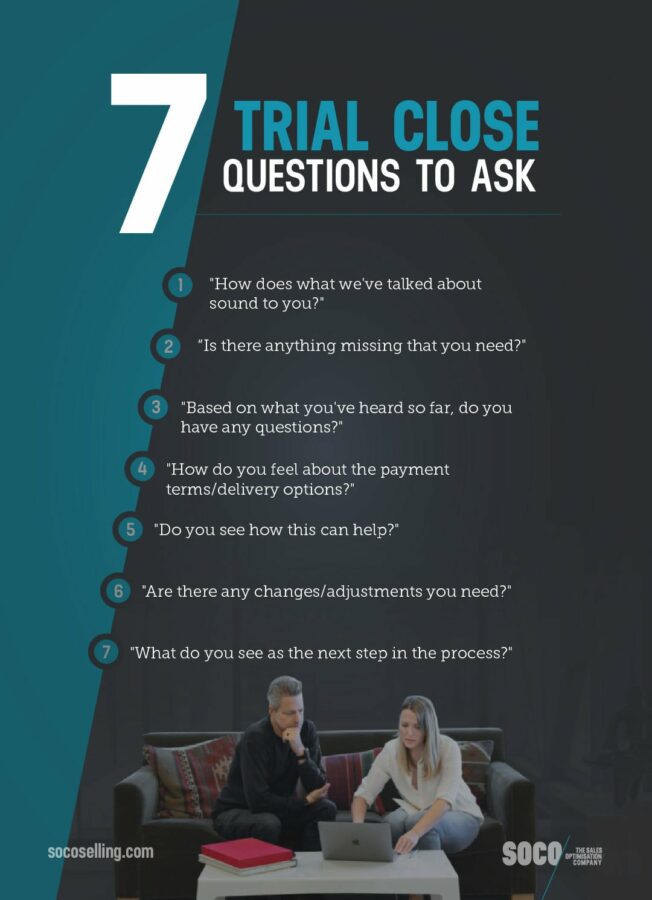
After reviewing their behavior for possible starting points, you can decide which open-ended question will most effectively gauge their interest in purchasing your product or service. For example, use these trial close questions to help you gauge where prospects stand in their decision journey while allowing you to address potential issues early—before they become major obstacles:
- How does what we’ve discussed sound to you?
- Is there anything missing that you need?
- Based on what you’ve heard so far, do you have any questions?
- How do you feel about the payment terms/delivery options?
- Do you see how this can help?
- Are there any changes or adjustments needed?
- What do you see as the next step in the process?
Learn more from How to Ask For The Sale Without Being Pushy
3. Identify Their Perspective
Prospects may respond to your questions in numerous ways—some might ask additional questions, others might share opinions, and some might raise concerns directly. You need to be prepared to engage appropriately regardless of which direction the conversation takes.
These interactions help you understand if your offering is a good fit for their specific situation and where they are on your sales timeline. For example, if prospects mention specific needs, such as requiring multiple weekly deliveries, craft a compelling response highlighting how you can accommodate high-volume, rapid fulfillment—while always remaining truthful about your capabilities.
4. Turning Objections into Opportunities
Ready to handle pushback or avoid it altogether? When using trial closes in your sales process, you must prepare for any concerns that surface through your open-ended questions. Remember that when prospects express hesitation, they’re simply telling you they need more convincing before they feel comfortable moving forward.
Prepare a list of common objections you’ve encountered and develop thoughtful responses that address why these concerns shouldn’t block the sale. Practice verbalizing these responses until they feel natural. Working with colleagues in mock scenarios creates the perfect environment to practice handling objections effectively. If no partner is available, record yourself to review your delivery and confidence.
You can also get a head start by reading our in-depth guide to handling sales objections here: The Ultimate Guide To Objection Handling.
When you use trial closes effectively, you’ll uncover objections that might otherwise remain hidden until it’s too late. Here’s how to address the most common responses:
When they say: “I need to think about it”
This usually means you haven’t uncovered their true concerns. Try:
- “What specific aspects do you need more time to consider?”
- “While you’re thinking, what questions can I answer right now?”
When they say: “It looks good, but the price…”
Focus on value rather than defending your price:
- “Which parts of the solution provide the most value for your organization?”
- “How does this compare to the cost of not addressing this challenge?”
When they say: “We need to discuss this with others”
Help them become your advocate:
- “What points will be most important to highlight when you discuss this with your team?”
- “What objections do you anticipate from the group, and how can I help address them?”
When they say: “Your competitor offers…”
Acknowledge the comparison but refocus on their needs:
- “What aspects of our solution align best with your specific requirements?”
- “Beyond features and price, what factors matter most in your decision?”
When they go silent
Silence after a trial close often signals confusion or concern:
- “I notice you’re taking some time to consider. What aspects would be helpful to explore further?”
- “Have I missed something important about your situation?”
Remember that objections revealed through trial closes aren’t roadblocks—they’re guideposts showing exactly what you need to address to move forward. By responding thoughtfully to these signals, you transform potential deal-breakers into stepping stones toward a successful close.
5. Adjust Your Strategy
After gathering feedback, tailor your offering to match your prospect’s specific needs. Pay close attention to their level of engagement during this process.
When prospects answer your questions but seem hesitant or give vague responses, they likely need more time before making a decision. On the other hand, positive body language like nodding and smiling suggests they’re ready for you to move toward finalizing the deal.
6. Move Towards the Final Close
After using softer questions like:
- “What are your thoughts so far?”
- “How well does this align with what you need?”
- “Do we need to cover anything else?”
The next step is shifting toward more direct questions about commitment. Try asking: “What steps would you like to take from here?” This question represents a true closing attempt. Remember that managing your sales pipeline is your responsibility, not your prospect’s. Many sales professionals make the mistake of giving a complete presentation without asking for commitment, only to have their prospect purchase from a competitor later. All their effort merely prepared the customer for someone else to close the deal.
So, while it’s important to use trial closes, you also need to make sure that when the time is right, you outright ask for the sale.
Trial Close Best Practices | Always Be Trial Closing
Attempting your first trial close can be daunting, primarily if you still rely heavily on traditional sales closing methods. That’s why we’ve provided you with helpful best practices you can use before, during, and after the trial close to ensure you’re on track: The Ultimate Guide To Objection Handling
Understand Customer Needs
So many salespeople go into a meeting ready to pitch a solution, and seemingly, it’s as though it doesn’t matter what the customer wants or needs. They already have a product or service in mind that they want to sell. While we all have quotas, targets, and KPIs to meet, we also have to focus on what’s important to the customer.
Struggling with this aspect? Read 10 Sales Needs Analysis Questions You Should Always Ask Prospects to formulate your sales needs analysis immediately.
Recognize Buying Signals
Buying Signals can be verbal or non-verbal signals that your prospective customer will give you as an indication of their readiness to move to the next stage of the sales process. Now, this is not an exact science, not always true, and not always confirmed, but if they are ready to buy, your job is to ask questions to discover what is holding them back.
Common buying signal examples
- Nodding: If you notice that your prospect is nodding while you’re speaking to them, that’s usually a good indicator that they’re interested and that they’re responding positively to what you’re saying.
- Leaning forward: If they’re leaning forward, that means they’re interested, engaged, and want to know more.
- Smiling: A universal symbol for “I like you, and I like this.”
- Asking questions: Questions mean that they’re interested and want to know more. They may even be considering how your solution could fit in their environment.
- Making positive statements: This is obvious, isn’t it? But when your prospect says things like, “Wow, neat. Cool. That’s interesting!” those are perfect signs they’re ready to buy.
Practice Active-listening
Listen carefully to what is most important to your customer before you start throwing in discounts. The more you listen, the more you understand what’s truly important to your customer. You might find that it’s more than just price. There could be some other concerns or things that are important to them beyond price – either way, it’s up to you to listen and find out.
Ask for Incremental Commitments
Rather than do one pitch meeting or a presentation and say, “Sign here,” you need to get your prospect to make small incremental commitments. A commitment would be an obligation or a promise, so an incremental commitment would be small, bite-sized pieces or portions. For example, you could ask your prospects to commit to:
- Meeting with you.
- Reading your proposal.
- Introducing you to a decision-maker.
- Scheduling a conference call with key stakeholders.
- Forwarding a survey to their staff to understand their needs before you propose something.
What you’re looking to do is gain a small commitment – something they can agree to do now that’s relatively easy. The idea is that by getting your customers to commit to small things and to follow through on those small things, you’re one step closer to closing those big deals.
Winning Trial Closes Across Different Industries
Effective trial closes can be tailored to different industries to address unique buying concerns.
Here are practical examples:
SaaS
- “How would having this dashboard functionality help your team make faster decisions?”
- “Based on what you’ve seen of our platform, which workflow problem would it solve first?”
Healthcare/Medical
- “From the patient management features we’ve discussed, which would most improve your practice efficiency?”
- “How do you see our diagnostic tool fitting into your current assessment process?”
Telecommunications
- “Looking at the coverage map, how would this network expansion benefit your remote teams?”
- “Which of these communication features would address the team collaboration issues you mentioned?”
The most effective trial closes focus on the specific value your industry solution delivers. Frame questions around how your offering solves the particular challenges your prospects face, making it easier for them to envision implementing your solution in their business.
Practice Makes Perfect: Trial Close Role-Playing Exercises
Reading about trial closes is one thing—mastering them requires practice. These role-playing scenarios may help you develop confidence and refine your approach in a low-risk environment:
Scenario 1: The Hesitant Decision-Maker
Setup: You’ve presented your solution to a prospect who seems interested but hasn’t shown clear buying signals.
Exercise: Practice using these trial closes:
- “Based on what we’ve discussed, how do you see this fitting into your current operations?”
- “Which aspects of our solution seem most valuable to your team?”
- “What concerns would need to be addressed before moving forward?”
Partner feedback: Have your role-play partner respond with vague or non-committal answers initially, then gradually reveal specific concerns. Practice identifying when to dig deeper versus when to present additional information.
Scenario 2: The Multiple Stakeholder Challenge
Setup: Your primary contact is enthusiastic but mentions needing approval from others.
Exercise: Practice these trial closes:
- “From what you know about your team’s priorities, which features would most interest them?”
- “What questions do you think other stakeholders might have?”
- “How do you typically build consensus for new solutions like ours?”
Focus on: Gathering intelligence about decision-making processes and identifying potential objections from absent stakeholders.
Scenario 3: The Price-Sensitive Customer
Setup: Your prospect has shown interest but keeps circling back to budget concerns.
Exercise: Practice these trial closes:
- “Aside from investment, what other factors are you weighing in your decision?”
- “How would you evaluate the return on this investment?”
- “What would make the value clearer in relation to the investment?”
Focus on: Shifting the conversation from price to value without dismissing budget concerns.
Implementation Tips
- Schedule regular 15-minute practice sessions with colleagues
- Record sessions to review your tone and timing
- Switch roles to understand the customer’s perspective
- Create industry-specific scenarios relevant to your actual prospects
Consistent practice of these scenarios will help you develop the instincts needed to use trial closes naturally in real sales conversations. There is also professional sales team coaching that can help your team master these techniques faster.
Trial Close Success Stories from Sales Experts
Top sales professionals consistently use trial closes to drive impressive results. Here’s how they’re putting these techniques into action:
The “Something Special” Approach
James Muir, a veteran sales trainer, uses what he calls the “Something Special” trial close to test buying readiness without offering premature concessions:
“Does it make sense for me to see if we can do something special for you if we can get everything wrapped up by the end of the quarter?”
This question helps gauge timing, positions you as an advocate and avoids committing to specific discounts too early. Sales teams using this approach report shorter sales cycles and fewer discounting issues.
Free Trials as Trial Closes
Justin McGill, founder of LeadFuze, found that offering free trials works as a powerful form of trial close. By letting prospects experience the product firsthand, his team:
- Builds prospect confidence through hands-on experience
- Shortens the sales cycle significantly
- Addresses objections naturally through actual usage
McGill’s team now converts 57% of demos into first-call closes using this strategy.
Leadership’s Impact on Trial Closing
Dana Denis-Smith of Obelisk Support transformed her company’s sales performance by bringing in experienced sales leadership that implemented structured trial closing techniques. This move helped her company rebound from a 50% sales decline to forecasting £7 million in revenue.
Common Mistakes to Avoid When Using Trial Closes
Even seasoned sales professionals can fall into traps when using trial closes. Here are the most common pitfalls to watch out for:
Poor timing
Rushing trial closes before building rapport or understanding customer needs can backfire. Give prospects enough information to form an opinion before asking for their thoughts. Wait until you’ve presented clear value before using trial closes.
Overusing trial closes
Bombarding prospects with constant opinion-seeking questions can make them feel pressured and exhausted. Space your trial closes throughout the conversation, using them at natural transition points in your discussion.
Not listening to responses
Many sales professionals ask trial close questions but don’t actually process the answers. Pay close attention to both verbal responses and body language. When customers give lukewarm responses, take time to address concerns rather than push forward.
Using closed questions
Questions that prompt simple yes/no answers limit the feedback you receive. Instead of “Does that sound good?” try “What parts of this solution seem most relevant to your situation?”
Misinterpreting buying signals
Not every positive response means the prospect is ready to buy. Be careful not to mistake politeness for genuine interest. Look for consistent positive signals across multiple trial closes before moving to the final close.
Forgetting to follow up
After receiving feedback through a trial close, many salespeople fail to acknowledge or address it. Always respond to what your prospect shares, adjusting your approach based on their feedback to demonstrate you’re truly listening.
Avoiding these common pitfalls will help you use trial closes effectively without derailing the trust you’ve built with your prospects.
Maximize your sales skills in only 12 weeks with personalized 1-1 coaching
You’re good at what you do, but know that there’s a next level.
That’s where our 12-week intensive Sales Mastery program comes in.
Our individual sales coaching program involves a tailored learning system consisting of e-learning, six 1-on-1 coaching sessions and email support.
We call it ‘intensive’ because it is – during the 12 weeks, you’ll be working on your sales skills, gathering and documenting your sales process, crafting new scripts and perfecting your craft.