


The old sales playbook is dead. Your top reps are spending less than 35% of their time actually selling, bogged down by repetitive research, data entry, and manual prospecting. To close bigger deals and accelerate your pipeline in the modern market, you need a secret weapon: AI sales and prospecting software. This definitive guide cuts through the noise to present the seven essential AI tools designed to instantly find high-intent leads, personalize outreach at scale, and automate your most tedious tasks. Read on to equip your team with the technology that separates the sales leaders from the laggards.
Key Takeaways: What You’ll Learn
- Get a breakdown of 9 top AI sales tools and what they do. You’ll learn how platforms like Outreach, 6sense, Gong, and GPTBots solve specific problems in prospecting, lead generation, coaching, and productivity.
- Understand the 6 main ways AI is used in a sales process. This guide covers how AI helps with everything from identifying high-intent leads and automating outreach to predictive forecasting and call coaching.
- Learn a 5-step plan for successfully integrating AI. Get a clear process for adding AI to your team, starting with setting goals, cleaning your data, and matching the right tool to your biggest challenge.
- Discover the 6 key benefits of adopting AI. You’ll see how these tools can improve forecast accuracy, optimize pricing, find more up-sell opportunities, and free up your reps’ time.
- Find out which tools are best for your specific needs. The article categorizes tools by their main function (Lead Generation, Prospecting, Coaching, etc.) so you can find the right solution for your team.
- Identify the 3 most common challenges to AI adoption. Learn about the potential barriers related to management, data quality, and team buy-in so you can plan for them in advance.
What is Artificial Intelligence in Sales?
Artificial intelligence in sales is an umbrella term for modern technology that effectively helps machines execute complex cognitive duties.
There are numerous smart technologies in artificial intelligence for sales that directly impact the success of your business. For instance, AI includes technology like Deep Learning, Machine Learning, Computer Vision, and Natural Language Processing, and Generative AI. When applied well, AI for sales can be a powerful tool.
Overall, it can help keep track of performance, optimize sales cycles through predictive analytics, and even predict leads that are most likely to buy.
What are the Benefits of AI for Sales?
While AI has become compulsory for businesses that want to grow in a competitive landscape, we understand you might still be on the fence about it. Here are several key reasons why your sales will benefit from adopting artificial intelligence:
- Improves business strategy development: Offloading monotonous tasks to AI for sales enables you to save time you can use to create strategies for generating more leads.
- Improves sales forecasting: AI for sales increases your overall forecast accuracy by providing a real-time view of the health of all the deals in the pipeline. This feature helps sales managers know when to act on advancing or stalling a deal.
- Optimises pricing: AI for sales helps salespeople process all the sales data about customers to develop a suggested price, including location, size, and past successful deals. They’ll never have to guess what price will help them win a sale ever again.
- Easier up-selling and cross-selling: With AI for sales, sales reps can better identify prospects who are likely to buy from them. They can also use an algorithm to determine which prospects will likely sign up for follow-up solutions.
- Facilitates the rise of leads: AI helps you reach specific and targeted prospects by connecting significant amounts of information. Which would usually be time-consuming and, thus, speed up the process to facilitate more leads.
- Saves time & reduces labor costs: Research has shown that sales reps spend only about a quarter of their time selling to customers. By automating repetitive tasks, you’ll ensure salespeople are focused on selling.
How is AI Used in Sales Today?
According to McKinsey research, sales teams who have adopted AI tools for sales have increased their leads and appointment bookings by about 50% – probably because AI for sales successfully takes on the time-consuming tasks of connecting with leads, qualifying, following up, and sustaining the relationship.
Are you curious about implementing AI for sales in your organization to improve efficiency, speed, and communication? Discover several different uses below:
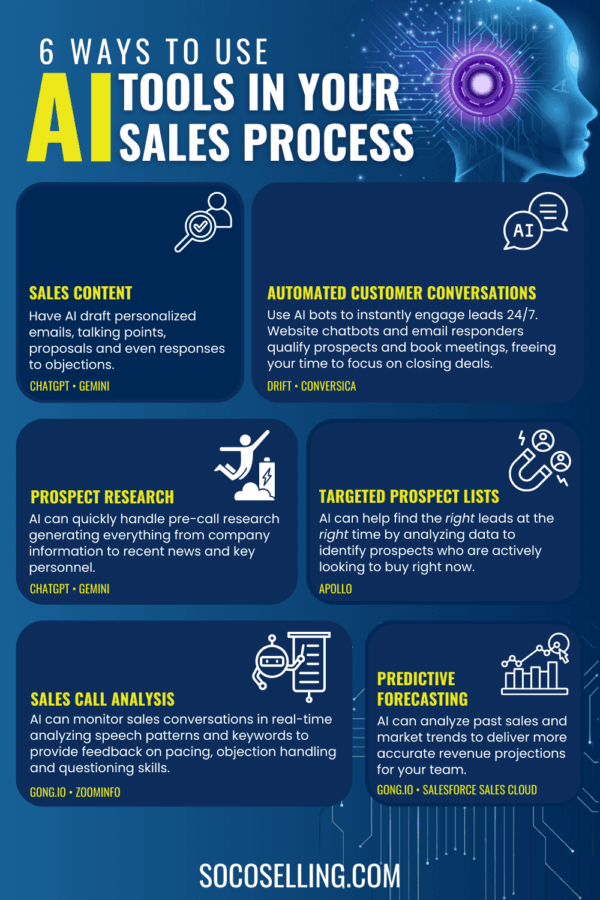
Lead Generation: Using AI to Create Your Target List
Instead of just generating a larger volume of leads, AI helps sales teams find the right leads at the right time. It does this by analyzing data to identify prospects who are actively looking to buy right now.
- Analyzing Intent Data: AI platforms can track billions of online signals to see which companies are suddenly researching topics related to your product, visiting competitor websites, or reading review sites. This “intent data” is a massive indicator of a prospect’s readiness to buy, allowing your team to reach out proactively.
- AI-Powered Lead Scoring: These systems can also analyze all your inbound leads, scoring them based on how closely they match your ideal customer profile and their recent behavior (like website visits or content downloads). This process automatically prioritizes the hottest leads at the top of a rep’s queue, ensuring they always focus their efforts on the opportunities most likely to close.
Skip to recommended lead gen AI tool
Prospecting: Engaging Prospects With AI-Assisted Outreach
Once you have your prioritized list of high-intent leads, the next challenge is to engage them with relevant and personalized outreach. This is where AI transitions from a strategic tool to a tactical co-pilot, helping your reps craft more effective communication at scale.
AI can dramatically speed up and improve the quality of your prospecting activities in several ways:
- Personalized Email & Message Crafting: AI can take the insights gathered during the lead identification phase (like a company’s recent funding announcement or a new job posting) and instantly draft a highly relevant email or LinkedIn message. This allows a rep to create a truly personalized first touch in seconds, rather than minutes.
- Generating Custom Call Scripts: A sales rep can feed an AI information about a prospect’s industry, role, and likely pain points to generate a custom call script or a list of key talking points. This ensures they go into every conversation prepared with insightful questions and relevant value propositions.
- Optimizing Outreach Cadences: AI can help structure a multi-touch prospecting sequence. It can suggest the ideal timing between touchpoints and help draft the messaging for each step, from the initial email to the follow-up call and the final check-in to maximize the chance of getting a response.
In this stage, AI doesn’t replace the salesperson. It handles the time-consuming research and writing, allowing the rep to focus on what they do best: having more high-quality conversations with the right people.
Skip to our recommended AI sales prospecting tool
Predictive Forecasting
While sales managers already usually do a great job at forecasting their sales teams’ numbers, AI tools for sales enhance these projections, often with a higher degree of accuracy.
AI looks at way more than just how many deals you have in your pipeline. It studies patterns from past sales, what’s happening in the market, and how different types of customers usually buy. In turn, organizations can be even more cost-effective when planning for production, inventory, and resources.
Also read:
- Revenue Acceleration Using Data and AI with Mark Kilens from Drift
- Using Sales AI to Qualify and Engage Leads with Gabriel Lim
- 3 Ways To Use Artificial Intelligence (AI) for Sales Training
Enhanced Team Performance & Productivity
AI streamlines the work that happens before and after sales meetings. Before calls, AI gathers relevant prospect information, recent company news, and suggests talking points based on the prospect’s industry and role.
After meetings, AI analyzes conversation recordings to automatically generate follow-up tasks, identify next steps, and create personalized email templates.
Studies show that sales professionals only spend about 34% of their time actually selling. By automating repetitive, laborious manual tasks at an everyday level, salespeople now have more time to do what they should be doing: build relationships and sell solutions to prospects’ problems.
Not only is ai for sales taking the weight off from data entry and routine work, but it’s also taking it to the next level with automated lead follow-ups, routine touches, and engagement.
Skip to recommended AI sales productivity tool
Sales Training & Coaching
AI doesn’t just help you find prospects. It makes your sales conversations more effective. Advanced platforms monitor speech patterns during calls to detect energy levels, interruptions, and empathy in real-time.
The AI analyzes how fast you’re speaking, when you’re listening versus talking, and whether you’re matching your prospect’s communication style. Some systems provide live feedback through your headset, suggesting when to slow down, ask a question, or shift your approach based on how the conversation is flowing.
Most organizations have vast amounts of employee, customer, product, and customer service data available to them, which sales teams can use to create a customized AI sales training program, often personalized to suit the individual needs of each learner by focusing on their skill and knowledge gaps.
Skip to recommended AI sales coaching tool
Automated Prospect & Customer Conversations
One of the most powerful uses of AI in sales is its ability to engage prospects and customers instantly, 24/7. This is done through a variety of AI-powered bots that handle initial communications, ensuring no lead goes cold.
- Chatbots & Voicebots: Deployed on your website or phone systems, these act as digital first responders. They can answer common questions, qualify visitor intent, and even book meetings directly on a sales rep’s calendar, all without human intervention.
- AI Email Responders: When a prospect fills out a “Contact Us” form or downloads a resource, an AI email bot can instantly follow up. It can engage the lead in a natural conversation to qualify their needs and budget before seamlessly handing them off to a human salesperson.
These tools handle the repetitive, top-of-funnel conversations, freeing up your sales team to focus their time on strategy and closing deals with well-qualified buyers.
Skip to recommended AI communication tools
The Future of Crafting Sales Emails and Outbound Sequences (ChatGPT, Gemini, Claude, Copilot)
Large Language Models (LLMs) have become essential tools that most professionals now have in their tech stack. Whether you’re using ChatGPT, Claude, Gemini, Microsoft Copilot, or other AI writing platforms, they can be used in multiple ways and always evolve with the latest updates to stay sharp.
One of the most popular ways to use it is as an AI-powered writing tool. These tools simplify the process of creating effective sales emails and outbound sequences.
They can help sales professionals generate personalized messages quickly, ensuring consistent communication with prospects. With these tools, you can produce a variety of templates that resonate with different audience segments.
Its understanding of language nuances contributes to higher engagement and conversion rates, as it can tailor the tone and style to match your recipient’s preferences. By automating part of the email creation, sales teams can focus more on sales strategies that turn prospects into customers and less on writing mechanics.
These AI assistants stands as a game-changer in the realm of sales, offering a robust platform for crafting personalized and efficient customer interactions. These conversational AI tools have revolutionized the sales process by automating routine tasks and providing real-time, actionable insights.
Sales professionals can now leverage any of these AI tools to streamline their workflow, from qualifying leads to handling customer inquiries and follow-ups. By integrating a tool like ChatGPT into their tech stack, sales teams can enhance productivity, improve customer experiences, and ultimately drive revenue growth.
As the digital landscape evolves, these AI assistants remain a vital asset for sales teams looking to stay ahead in a competitive market.
What are the Challenges of Adopting AI for Sales?
Like all new technology-based implementations, there will be some potential obstacles organizations need to address before getting started. Barriers can appear in any of the following areas:
- Management: It may be necessary to build demonstrable use cases to persuade executive buy-in from key stakeholders if your budget is lighter.
- Data: Organizations must ensure they possess robust data to secure a 360-degree view of their customers.
- People: Sales teams stuck in their ways might find adopting new processes difficult or even fear becoming redundant in their role as AI for sales technology continues to develop.
The Best AI Tools for Sales
To help you get started on your journey with artificial intelligence in sales, we’ve outlined some of the best AI tools for sales:
AI Prospecting Tools
Modern prospecting requires precision and scale. These AI tools handle automating prospecting research, outreach, and follow-up that traditionally consumed hours of your team’s time.
1. Outreach.io: AI-Powered Sales Engagement
Outreach is a top-tier sales engagement platform that helps teams automate and improve their customer interactions.
- Personalized Email & Message Crafting: The platform’s AI assistant helps draft relevant and personalized emails, suggesting content based on conversation context.
- Generating Custom Call Scripts: Outreach’s AI, “Kaia,” joins live calls and provides real-time talking points, content suggestions, and objection-handling tips.
- Optimizing Outreach Cadences: Its “Sequences” are the heart of the platform, allowing reps to execute and test multi-step outreach. The AI analyzes performance to recommend optimizations.
Choose this if: You want a platform that provides real-time AI assistance during live calls in addition to robust email sequencing.
2. Hubspot (Sales Hub): CRM with Sales Automation
A very popular choice as it’s built directly into the HubSpot CRM, providing a seamless experience. HubSpot’s Sales Hub integrates sales engagement tools directly into its popular CRM and allows reps to use AI to draft personalized emails and enroll contacts in automated outreach “Sequences.” Its main benefit is having all customer data and outreach tools seamlessly connected.
Choose this if: You already use HubSpot’s CRM and want a fully integrated tool for sales email automation and sequencing.
Lead Generation AI Tools
Smart lead generation means knowing who’s ready to buy before they tell you. These tools monitor buying signals and score prospects based on intent.
3. 6sense: Revenue AI for Intent Data & Scoring
6sense is a Revenue AI platform that excels at both identifying and prioritizing opportunities. It analyzes billions of anonymous online signals to find accounts that are actively researching solutions like yours, then uses AI-powered scoring to rank both the accounts and the specific people within them, so you know exactly who is ready for a conversation.
Choose this if: You want to find anonymous accounts showing buying signals and get a prioritized list of who to contact within them.
4. Demandbase: ABM Platform with Intent & Scoring
Demandbase provides a comprehensive platform for Account-Based Marketing (ABM) that combines intent data with predictive scoring. It helps sales and marketing teams work together by identifying which target accounts are showing interest and then scoring their engagement to focus resources on the most promising opportunities.
Choose this if: You want a single, unified platform to manage your entire account-based marketing strategy, from discovery to closing.
AI Sales Productivity Tools
Your team’s time is valuable. These productivity tools automate routine tasks so your reps can focus on what they do best – building relationships and closing deals.
5. GPTBots: Complete AI SDR Agent
GPTBots takes the heavy lifting out of your sales development process by automating over 80% of typical SDR tasks freeing up your team for high-value activities. The AI handles research, outreach, and follow-ups while keeping your CRM organized and current.
What sets it apart is how seamlessly it integrates with your existing CRM, so your sales data stays organized and accessible. Your team gets more qualified leads without the manual grunt work.
Choose this if: You want an enterprise-grade platform that handles sales automation as part of a broader AI strategy across your entire organization. You want one platform to handle your entire sales workflow without switching between tools.
AI Sales Coaching Tools
Great coaching turns good reps into top performers. These AI tools analyze what’s working and provide actionable feedback to improve results.
6. Gong: Data-Driven Performance Insights
Gong records and analyzes your sales conversations to identify patterns in successful deals. The platform provides predictive insights about which opportunities will close and offers specific coaching recommendations based on real performance data.
Choose this if: You want to understand what separates your top performers from the rest and need predictive deal intelligence
7. Nooks: Real-Time Call Coaching
Nooks gives your reps live feedback during calls, suggesting optimizations based on what actually converts prospects. The platform analyzes conversation flow and helps reps adjust their approach on the spot for better outcomes.
Choose this if: Your reps need immediate feedback during calls to improve their performance in real-time.
AI Communication Tools
8. 6sense: AI Email Agents
After acquiring Saleswhale, 6sense integrated this AI email conversation functionality into its broader Revenue AI platform. It combines intent data (knowing who is ready to buy) with an AI assistant to engage them proactively.
Choose this if: You want to automatically start email conversations with in-market accounts that have been identified by intent data.
9. Conversica: Start Conversations with Customers Using AI Agents
This tool is a leader in the space, and their entire platform is built around providing AI Assistants that engage leads across email and SMS in a human-like, two-way conversation to qualify them for sales.
Choose this if: You need to automate the follow-up and qualification process for inbound or dormant leads with a human-like AI assistant.
How to Incorporate AI into Your Sales Team
Getting AI tools for your sales team isn’t just about picking the right software. You need a plan to make sure it actually works. Here’s how to do it right:
1. Know What You Want to Achieve
Before buying any AI tool, figure out exactly what you want it to do. Do you want more leads? Faster deals? Less time on boring tasks?
Write down specific goals like “get 40% more qualified leads” or “close deals 25% faster.” This helps you pick the right tool and know if it’s actually working.
2. Clean Up Your Data First
AI learns from your existing customer information. If that information is messy, outdated, or full of mistakes, your AI will give you bad advice.
Before adding AI, spend time organizing your customer data. Remove duplicates, fix errors, and fill in missing information. Think of it like cleaning your room before inviting friends over. Everything works better when it’s organized.
3. Match the Right AI to Your Biggest Problems
Different AI tools solve different problems. If your biggest issue is finding good leads, get AI that’s great at lead scoring. If writing personalized emails takes forever, get an AI that handles message customization.
Don’t try to solve every problem at once. Focus on your biggest pain point first.
4. Make Sure Everything Integrates with Current Software
Your new AI tool needs to work with the software your team already uses daily. If it doesn’t connect to your CRM or email system, your team will spend more time moving information around instead of selling.
Check how the AI will fit into your current setup before you buy it.
5. Test Before You Trust
Your team needs to believe the AI actually helps before they’ll use it. Start small – test the AI’s suggestions against results you already know.
When AI says “prioritize these leads,” track whether those leads really do convert better. Show your team the proof so they trust the recommendations.
The New Sales Reality: Adapt or Get Left Behind
Whether you choose one of the above solutions or all of them, AI technology is here to stay. It allows sales professionals and teams to sell smarter with less effort.
“AI won’t replace salespeople, but salespeople using AI will replace those who don’t.”
This quote captures the current reality. AI won’t take over sales roles, but sales professionals who embrace AI gain a significant competitive advantage over those who stick to traditional methods.
So many sales software options have AI elements in the market. Ranging from easy improvements to complicated sales process overhauls. As a result, choosing the right one is a challenge for even the most experienced sales team leader.
AI Powered Sales Training
Many sales reps are already using tools like ChatGPT or Gemini to craft emails. But there’s a more advanced way to use AI that most reps don’t know about. By unlocking AI’s full potential, your team can get more done in less time, allowing them to focus on what they do best: building relationships and closing deals.
Our AI Powered Sales Training focuses on advanced prompts and systems for AI tools they already have access to.
Help your team use AI to handle objections better, personalize outreach, and close more deals.

Some really cool apps and products here that I had no idea about before reading this. Some potential game changers for sales people no doubt if they are embraced. Thanks Tom.